Still Running a 2010 Playbook? Your Customers Have Already Left.
Customer behaviour has changed permanently. Most transformation strategies haven't caught up.
There is a quiet assumption I still encounter in boardrooms: that customer expectations evolve gradually, and that a strong brand built over decades provides enough cushion to adapt at a comfortable pace.
That assumption is no longer safe.
Customer behaviour has not evolved gradually over the past decade — it has reset entirely. The pandemic compressed years of digital adoption into months. AI-driven personalization, instant fulfilment, and on-demand everything have rewired what customers consider normal. And the companies still operating on a 2010-era model of customer engagement — even strong, profitable ones — are accumulating a kind of structural risk that does not show up in quarterly results until it is too late to reverse.
The Expectation Gap Is Wider Than Most Leaders Realise
A decade ago, a customer might tolerate a multi-step booking process, a delayed response, or a one-size-fits-all service experience, because the alternative was calling a competitor who offered roughly the same thing.
That competitive cushion is gone.
Today's customer compares every experience — booking a rental car, opening a bank account, requesting support — against the best digital experience they had that morning, regardless of industry. If a ride-hailing app gets them a car in ninety seconds with full price transparency, that becomes the implicit benchmark for every other service interaction in their life, including yours.
I saw this directly in the mobility sector. For years, the car rental industry operated on processes designed for a pre-smartphone customer: paperwork-heavy counters, opaque pricing, and limited self-service. It worked, until it didn't. Newer entrants — leaner, digital-first, built around instant booking and radical transparency — didn't out-market the incumbents. They simply met customers where customer expectations had already moved to.
The uncomfortable lesson I took from this: the threat rarely announces itself as a competitor doing something dramatically better. It looks, at first, like a slightly more convenient alternative that customers quietly start preferring.
Why "We're Doing Fine" Is the Most Dangerous Sentence in Leadership
I have sat in strategy reviews where solid financial performance was used as evidence that transformation could wait. I understand the instinct — when the numbers are healthy, urgency is hard to manufacture.
But healthy numbers today are a lagging indicator, not a forward signal. Customer loyalty built on habit and switching cost is eroding faster than most companies' internal metrics can detect, because digital-native competitors have made switching nearly frictionless.
The companies most at risk are not the ones performing badly. They are the ones performing adequately, with leadership teams who interpret stability as proof that transformation is optional rather than overdue.
What Actually Needs to Change — Beyond the Buzzword
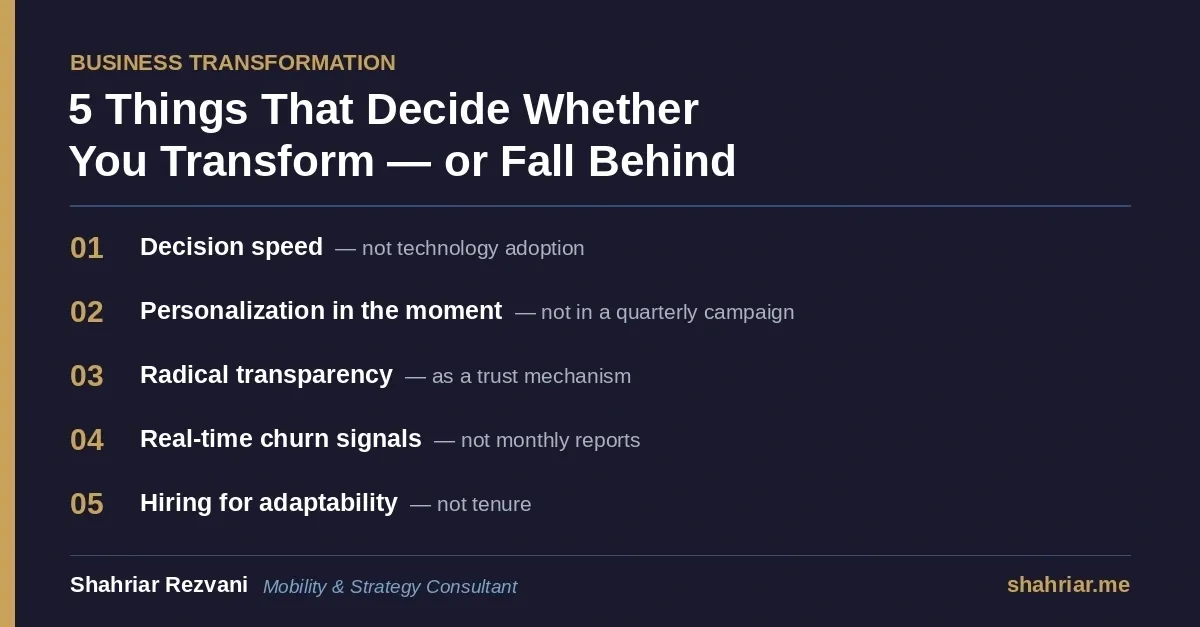
"Digital transformation" has become a phrase so overused that it risks losing meaning. Having watched this play out up close, I've come to believe most transformation failures aren't about technology gaps at all. They're about five specific, less comfortable things.
Decision speed, not technology adoption. This is the one most companies get backwards. They buy AI tools, new CRMs, automation platforms — and then route every decision through the same five committees they had in 2010. The technology becomes a faster horse pulling the same slow cart. The real fix is pushing decision rights down to the people closest to the customer, and shrinking the number of approvals needed to act on what customers are saying right now.
Personalization at the point of interaction, not in a quarterly campaign. Customers no longer separate marketing from product from service — they expect the company to already know them at every touchpoint. Most legacy companies still personalize in batches, like a targeted email campaign, rather than in the moment, like an app adjusting what it shows you right now. This is the most visible gap between digital-native and legacy competitors.
Radical transparency as a trust mechanism. This one is underrated. Customers today distrust opacity by default — hidden fees, vague terms, "contact us for pricing." The companies winning right now are over-explaining: real-time pricing, visible inventory, clear timelines. Transparency has quietly become a competitive advantage, not just an ethical nice-to-have.
Treating churn signals as urgent, not as a monthly report. Most companies still review customer attrition retrospectively, as a slide in a monthly business review. By the time it's on a slide, you've already lost the customer — and probably ten others like them. What matters is building systems that flag dissatisfaction in real time and route it to someone empowered to act immediately, not next month.
Hiring and promoting for adaptability, not tenure. This is the most uncomfortable one, and the one I feel most strongly about. Too many legacy organisations still reward loyalty and institutional memory over the ability to unlearn old habits. The leaders who actually drive transformation are rarely the people who've been doing things "the right way" for fifteen years — they're the ones still curious enough to question it.
A Final Thought
The question is no longer whether to transform. That debate ended years ago, even if some leadership teams haven't admitted it yet.
The real question is whether you'll lead that shift on your own terms — or get forced into it later, after the warning signs have become impossible to ignore and the cost of catching up has multiplied.
Your customers have already left the 2010 playbook behind. The only thing still deciding whether your business survives the next decade is whether you're willing to leave it too.